Build-Bench: Benchmarking LLM Agents on Compiling Real-World Open-Source Software
Zehua Zhang, Ati Priya Bajaj, Divij Handa, Siyu Liu, Arvind S Raj, Hongkai Chen, Hulin Wang, Yibo Liu, Zion Leonahenahe Basque, Souradip Nath, Vishal Juneja, Nikhil Chapre, Tiffany Bao, Yan Shoshitaishvili, Adam Doupé, Chitta Baral, Ruoyu Wang
School of Computing and Augmented Intelligence, Arizona State University, Tempe, AZ 85281, USA zzhan645, atipriya, dhanda, chitta, fishw @asu.edu
Reviewed on OpenReview: https: // openreview. net/ forum? id= BxJnz9EqO5
Abstract
Automatically compiling open-source software (OSS) projects is a vital, labor-intensive, and complex task, which makes it a good challenge for LLM Agents. Existing methods rely on manually curated rules and workflows, which cannot adapt to OSS that requires customized configuration or environment setup. Recent attempts using Large Language Models (LLMs) used selective evaluation on a subset of highly rated OSS, a practice that underestimates the realistic challenges of OSS compilation. In practice, compilation instructions are often absent, dependencies are undocumented, and successful builds may even require patching source files or modifying build scripts. We propose a more challenging and realistic benchmark, Build-Bench, comprising OSS that are more diverse in quality, scale, and characteristics. Furthermore, we propose a simple yet strong baseline LLM-based agent, OSS-Build-Agent, an effective system with an enhanced build instruction retrieval module that outperforms the prior rule-based and agentic baselines we evaluated on Build-Bench and is adaptable to heterogeneous OSS characteristics. We also provide a detailed analysis of compilation-method design choices, relevant information-retrieval modules, and their influence on the whole task, providing insights to guide future advances. We believe that performance on Build-Bench can reflect an agent's ability to tackle compilation as a complex software engineering task, and, as such, our benchmark will spur innovation with a significant impact on downstream applications in software development and software security. The data and code are released at https://github.com/StevenZ904/BuildBench.
1 Introduction
Imagine that you are a graduate student during a rebuttal period. The reviewers strongly suggested that you compare your system with prior work. It was only published a few years ago, so you find the GitHub repo, download the code, and read the included docs. It doesn't compile. The dependency URLs are missing. Required libraries aren't included. Even if it worked perfectly when first published, it's going to take you days to even compile this system. This scenario highlights the difficulty of compiling once-maintained open-source code, and in fact this problem is faced by the broader software engineering community. However, recent advances in Large Language Models (LLMs) promise to improve various software engineering tasks (Brown et al., 2020; Touvron et al., 2023; Chen et al., 2021). While commercial software can be developed with stringent and consistent engineering practices, OSS projects are highly heterogeneous. Additionally, OSS projects are maintained by varied contributors, adopt various build frameworks, and frequently require platform-specific configurations.
Compiling OSS often requires manual intervention to resolve missing dependencies, version mismatches, or undocumented environment requirements. Although prior rule-based methods (e.g., GHCC (Hu, 2020) and Assemblage (Liu et al., 2024)) attempted to automate this process by iteratively invoking build scripts, they cannot robustly handle dependency, toolchain, or platform mismatches. These challenges impact human software engineers who integrate OSS into their own applications, as this requires compilation to turn the software into a library or binary that they can use in their own system. Reliable and scalable automated compilation, in addition to improving software engineering, has other research benefits: It enables large-scale usage of binary data sources, supports program analysis and vulnerability discovery, and accelerates software maintenance workflows (Lacomis et al., 2019; Dramko et al., 2023; Pal et al., 2024). This work addresses these challenges by using LLM-based agents to automate OSS compilation at scale.
LLMs that are pre-trained on a large amount of natural language data exhibit strong performance in generalpurpose tasks, even with zero-shot prompting (Kojima et al., 2023). This capability is generalized to software engineering-related tasks, such as code generation, software debugging, documentation generation, and code refactoring. As such, LLM-based AI agents (Yao et al., 2023; Shinn et al., 2023), which are autonomous systems that use LLMs to iteratively plan, reason, and act, are increasingly used to automate and facilitate complex software engineering workflows (Wang et al., 2024). In this context, we position OSS compilation as a challenging and underexplored target for LLM-based agents. We are thus motivated to create a benchmark (Build-Bench) and systematically evaluate various, specifically agentic, solutions. Build-Bench includes the 148 repositories that human evaluators could compile out of 385 randomly selected C/C++-heavy OSS repositories from GitHub. Each retained repository is manually annotated for compilation success and build-instruction retrieval. We use the human-compilable subset as the final benchmark for evaluation. We use an additional 70 carefully chosen projects as a validation set to support the development of our agentic baseline method, OSS-Build-Agent. Using Build-Bench, we evaluate existing rule-based and LLM baselines and agentic compilation methods. We showcase the current shortcoming of rule-based methods in compilation performance and success verification. For LLM and agentic compilation methods, we inspect in detail the performance discrepancies among various compilation system designs. Specifically, we demonstrate the effectiveness of our LLM-Assisted Retrieval and Multi-Agent Compilation module design through a side-by-side comparison to another agentic solution. Through the release of Build-Bench and our analysis, we encourage researchers to create better agentic solutions for the compilation task, which will ultimately benefit the AI, software engineering, and software security communities.
Contributions. Our contributions are as follows:
- We created Build-Bench, which contains a hand-picked validation set and a test set obtained by randomly sampling 385 repositories and retaining the 148 that passed manual compilation and verification. Its labels support rigorous, systematic evaluation of OSS compilation techniques.
- We evaluated rule-based, single-turn, task-specific agentic, and general-purpose coding-agent methods on Build-Bench. Our proposed OSS-Build-Agent with LLM-assisted retrieval achieved the best validated build performance among the evaluated methods. With Claude 4.6 Sonnet, it reached a 76.4% strict validated success rate and an 80.4% flexible validated success rate, while Build-Bench remains a challenge for future research.
- We offered a detailed inspection of various design approaches in compilation instruction retrieval and error resolution modules and their effects on task performance.
2 Constructing Build-Bench
A benchmark for automated OSS compilation should cover the long tail of OSS rather than only highly popular projects. We first analyze the prior work CompileAgentBench (Hu et al., 2025), which also targets the automatic compilation task. Specifically, it consists of 100 popular and well-known GitHub projects, averaging over 8,000 stars. However, this focus on popular repositories overlooks the vast majority of OSS: 99.88% of C/C++ projects on GitHub have fewer than 500 stars. Therefore, the generalizability of evaluation results on CompileAgentBench may be undermined by projects that are unusually well documented, well maintained, and less representative of the in-the-wild challenges.
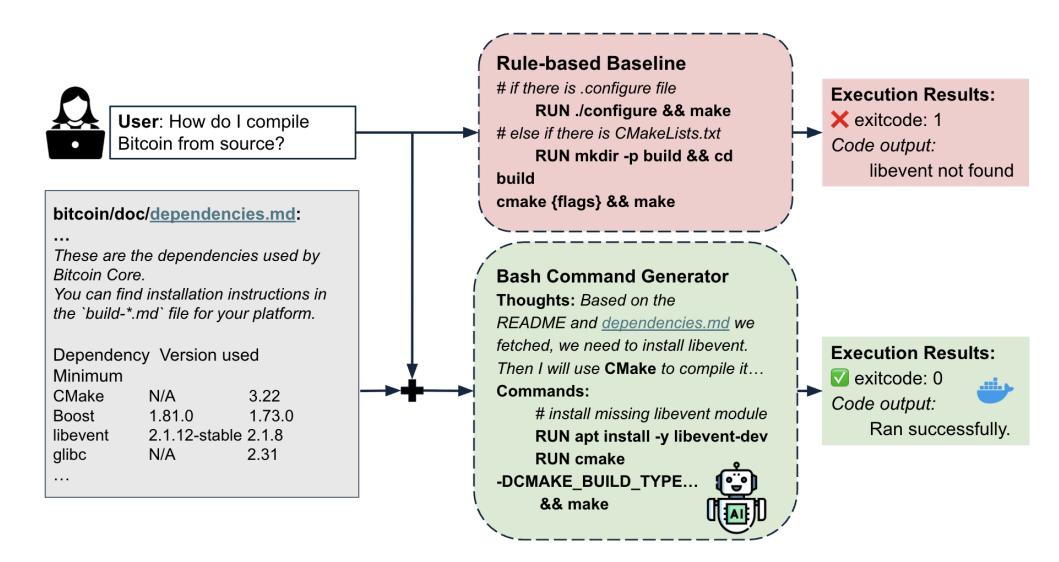
Figure 1: Demonstration of rule-based and AI agentic compilation methods. While rule-based methods follow a predefined workflow, they cannot adequately adapt to different environments. In comparison, AI agents leverage their pre-trained knowledge to adjust the compilation commands based on execution results. In this example, the agent realizes that libevent is a key missing dependency for Bitcoin to compile and installs it to successfully compile the project.
Data Filtering. We therefore construct a randomly sampled raw test set that better covers the broad diversity of OSS. To create the raw dataset, we collected 2.77M C and 4.23M C++ repositories using the GitHub REST API over a date range from April 1, 2008, to January 1, 2024. To remove extremely low-quality repositories, we apply a few filters: We exclude projects with names or descriptions that contain certain keywords (e.g., homework or assignment, more in Appendix A) or that have a stargazer count below 50 to ensure the OSS are meaningful for both practical usage and research purposes. For deduplication, we exclude repositories that are forks of other repositories. After filtering, the raw dataset contains 6.57M repositories. From this population, we randomly select 385 projects, the minimum sample size required to measure a population proportion with 95% confidence with a margin of error of 5%, according to Cochran (1977) (details in Appendix B). We believe that this random sampling helps ensure that Build-Bench better approximates real-world OSS compilation challenges.
Data Selection and Labeling by Human Experts. Due to the random sampling process, we cannot guarantee that all of the 385 projects can be compiled. Therefore, human experts manually built each repository to determine its validity. We also exclude OSS repositories that fit the following criteria: (a) The repository targets another operating system and cannot be cross-compiled; (b) The repository only contains trivial or unbuildable content; (c) The repository is missing critical source files and broken dependencies that cannot be installed or created; (d) There are compilation and linking errors that human experts cannot resolve in a best-effort setting.
This process yielded 148 compilable repositories as the final test set. The final test set is therefore the human-compilable subset of the randomly sampled 385 repositories, rather than an unfiltered statistically representative sample of all C/C++ repositories. More details can be found in Appendix Section I.
For each of the 385 raw test repositories, an initial evaluator first inspects whether build instructions are available, typically in the form of Bash commands or natural-language descriptions provided by the developers. For all repositories, the evaluator starts from the README file at the root level, then iteratively attempts to retrieve the file or external webpage that carries the build instructions. When available, the evaluator records the trajectories from the README file to the path of the build instructions and attempts the compilation following the retrieved instructions. If build instructions cannot be retrieved or are unavailable, the evaluator attempts to compile with the apparent build system and standard C/C++ build workflows. If a repository
compiles, the evaluator records a reproducible sequence of commands in a Dockerfile and directs outputs to a designated artifact directory using compiler, linker, or build-system output flags where appropriate. The resulting artifact names and build-instruction trajectory are recorded as labels. If all best-effort attempts failed, or no usable build system could be identified, the repository was labeled non-compilable.
A final evaluator independently rebuilt every retained Dockerfile and checked that the claimed artifacts appeared in the designated directory. Any mismatch was returned to the initial evaluator for correction and re-verification. The final evaluator also reviewed each build-instruction trajectory for consistency. The annotation involved 12 graduate students, each with more than three years of systems-research experience, and required roughly 150 hours.
For reproducibility, all repositories are evaluated at the fixed commits used during benchmark construction. We additionally cache the terminal instruction sources used by the perfect-retrieval setting, including external webpages and in-repository documentation, so that the inputs can be reconstructed even if upstream content changes.
We also created a validation set of 70 popular repositories used to develop OSS-Build-Agent.
The representativeness (or diversity) of a benchmark for the compilation task is essential to evaluate the generalizability and performance of any compilation technique. We analyze the representativeness from the following two aspects: popularity distribution and build system distribution.
Popularity. The number of Stargazers (or stars) of a GitHub repository is often used to approximate popularity and perceived quality (Dramko et al., 2023). A higher number often correlates with popular or essential functionality, better code quality, and an active development community that supports continuous and frequent maintenance. However, a majority of repositories tend to have relatively lower star counts than highprofile projects such as OpenSSL or FFmpeg. This is partially because repositories are often created for specific use cases and target smaller and specialized audience groups instead of having widely applicable use cases. Meanwhile, most repositories are for personal or experimental use, further undermining their limited visibility.
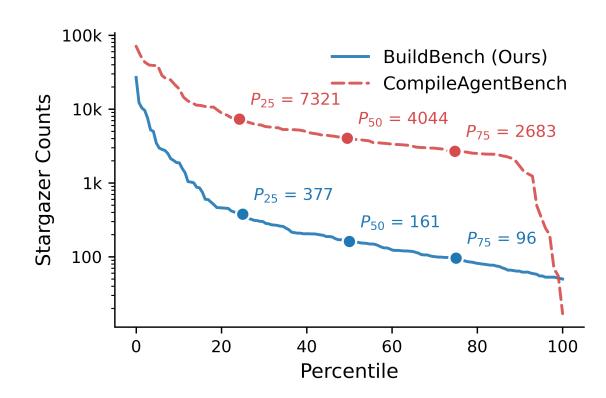
Figure 2: Distribution of stargazer counts of Build-Bench and CompileAgentBench. In Build-Bench, relatively low-profile repositories
made up the majority of the dataset. Build Systems. We further analyze the build systems and toolchains used in Build-Bench repositories: 62 projects use Make, 60 use CMake, 29 use Autotools, and 14 use Visual Studio (MSBuild). Smaller—but nonnegligible—subsets adopt alternative systems such as custom scripts, QMake, Meson, etc. Ten repositories provide no explicit build system, often relying on direct compilation. This diversity showcases the heterogeneity of real-world OSS, where the build system selection often depends on the project domain, platform, and community preference. Note that there may be multiple build systems available in the same OSS, offering alternative compilation approaches.
Figure 2 shows the Stargazer counts of repositories in Build-Bench and CompileAgentBench. Most repositories in Build-Bench are in the 50–500 range, indicating that the random selection results coincide with the long-tail distribution of overall repository popularity. This characteristic makes Build-Bench more challenging for evaluating compilation techniques, because lowprofile repositories often lack documentation or require additional customization or configuration. In contrast, the Stargazer counts of CompileAgentBench repositories are aggregated between 2k and 10k, and these popular repositories might be considered an underestimation of the true difficulty of the compilation task.
Build Instruction Sources. 136 out of 148 Build-Bench test set repositories have build instructions available. 18 of these repositories have build instructions hosted outside the repository. We released the information about repositories in the final compilable test set in Appendix Section I.
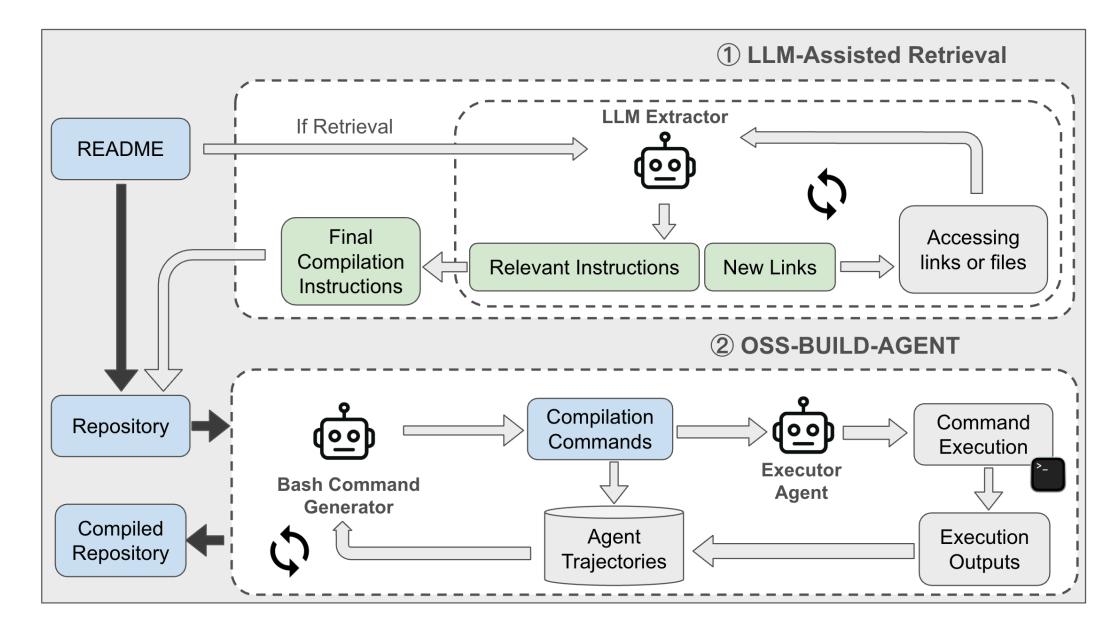
Figure 3: OSS-Build-Agent system diagram. The initial input is the README; then an optional LLM extends this with additional compilation instructions. Finally, a multi-agent build system iteratively generates and executes compilation steps, attempting to compile the target repository.
Overall, the results show that Build-Bench adequately represents a wide variety of real-world C and C++ projects and is suitable as a benchmark for evaluating automated build techniques.
3 Agentic Building Methods
We create an agentic compilation technique, OSS-Build-Agent. As Figure 3 shows, an initial (and optional) LLM iteratively extends the README with additional compilation instructions, and then a multi-agent build system iteratively generates and executes compilation steps.
3.1 Compilation Instruction Retrieval
Build scripts such as Makefiles are often lengthy, noisy, and machine-oriented, making them undesirable retrieval targets for both humans and AI agents when seeking clear, actionable build instructions. Many repositories with complex build processes or specialized configurations document these steps explicitly for human developers, and retrieving such information provides an effective foundation for agents to generate accurate compilation commands.
However, we find that such instructions are located not only in the OSS repository's README but also in other files inside the repository or on another website. To solve this challenge, we propose an LLM-Assisted Retrieval module, an optional component that precedes OSS-Build-Agent.
Our approach uses an out-of-the-box LLM as an incremental retriever to synthesize the complete set of instructions required for compiling a given repository.
The process uses the project's README as input. The LLM then iteratively performs three operations: (i) it distills potential compilation instructions from the file, (ii) it evaluates the sufficiency of the acquired information, and (iii) if the information is not sufficient to support compilation, it identifies promising hyperlinks, encompassing both internal files (whose paths are also parsed as valid URLs to ensure consistency) and external web pages. The contents of up to three newly identified links are subsequently fetched, summarized, and re-evaluated. This recursive process of retrieval and refinement continues until the LLM's confidence in the completeness of the build knowledge is sufficient or a maximum of three iterations is reached. The output of the retrieval module is the final set of compilation instructions, which is then passed to the agentic compilation framework.
3.2 Multi-Agent Compilation System
The compilation system comprises two cooperating agents, both using an out-of-the-box LLM of the user's selection: Bash Command Generator is given the final compilation instructions from the prior module (if using LLM-Assisted Retrieval) and the repository as input and produces a candidate sequence of bash commands to compile the repository. Execution Agent runs these commands within a containerized environment and returns the execution results. Prompts are included in Appendix Sections C.3 and C.4. For refinement steps k = 0, . . . , K, let Ck be the input into Bash Command Generator, which produces Sk, the commands to be executed by Execution Agent in the environment that returns execution results fk.
Initialization. Bash Command Generator produces the first set of commands directly from the input prompt C0 because there is no execution feedback. Execution Agent runs the generated commands S0 in a fresh Docker container, yielding the initial execution results f0.
Iterative Error Resolution. This constitutes the standard agentic loop: Bash Command Generator uses both Ck and the latest execution results fk to craft revised commands Sk, which the Execution Agent then executes again. Note that all potential error information in fk results from the execution errors of incorrect Bash commands generated by agents.
The process ends when Success(fk) = true or when k = K, the maximum number of turns allowed. This iterative error resolution process enables the compilation to recover from missing dependencies, incorrect flags, or environmental mismatches, an ability that is required for the OSS compilation task, as we analyze in Section 6.
4 Baseline Methods
In this section, we present existing rule-based techniques as well as two LLM-based compilation methods we compare against.
GHCC. GHCC (Hu, 2020) is a rule-based tool for building GitHub repositories. Prior research uses datasets that GHCC created (Lacomis et al., 2019; Xie et al., 2024). Given a repository, GHCC attempts to build the project by first discovering all build system-specific files (e.g., Makefile and CMakeLists.txt) and then conducting a rule-based build routine customized for these build systems.
Assemblage. Assemblage (Liu et al., 2024) is a system designed to automate the construction of binary datasets of primarily Windows executables by building source code. It follows a rule-based compilation workflow similar to that of GHCC.
Single-turn LLM baseline. To evaluate the project-building performance of pretrained LLMs on a single-turn basis, we prompt an out-of-the-box LLM to generate a set of Bash commands to build a target repository and execute the commands in a Docker container. The input to this baseline is the README file and file directory of the OSS's root directory. Without any execution feedback, this single-turn baseline cannot adjust its initial output. (Prompt in Appendix C.2.)
CompileAgent. CompileAgent (Hu et al., 2025) also introduces a multi-agentic compilation system. It adopts a flow-based agent strategy in which a master agent orchestrates the build process across two core modules: (1) CompileNavigator for locating and extracting build instructions and (2) ErrorSolver for resolving compilation errors. These modules are supported by five specialized tools (shell execution, file navigation, instruction extraction, web search, and multi-agent discussion), four of which involve auxiliary LLM agents, totaling seven agents in the pipeline. We include its official open-source implementation as a baseline in our evaluation to provide a representative comparison against our agentic approaches.
Table 1: Performance of all evaluated build techniques on Build-Bench test set. Section 5 describes the evaluation metrics of completion and validated successes.
| LLM Usage Build | Method | Unvalidated Completions % | Validated Strict | Successes % Flexible |
|---|---|---|---|---|
| N/A GHCC | 30.2 | 10.1 | 13.4 | |
| N/A Assemblage | 10.7 | 6.0 | 9.4 | |
| Single Turn LLM | Baseline | |||
| o3-mini | 63.5 | 33.1 | 36.5 | |
| GPT-4o | 60.8 | 30.4 | 32.4 | |
| Claude | 3.7-Sonnet | 64.9 | 37.2 | 39.9 |
| Gemini | 2.5 flash | 60.8 | 34.5 | 37.2 |
| Qwen3 | 235B | 62.2 | 33.8 | 35.8 |
| Qwen3 | Coder 480B | 65.5 | 35.8 | 38.5 |
| Multi-Agents | CompileAgent (with Retrieval) | |||
| GPT-4o | N/A | 50.7 | 56.8 | |
| Qwen3 | 235B | 66.2 | 45.9 | 54.0 |
| Coding Agent Claude | Code (Claude 4.6 Sonnet) | 93.9 | 70.3 | 78.4 |
| Multi-Agents | OSS-Build-Agent w/o Retrieval (Ours) | |||
| GPT-4o | 56.8 | 38.5 | 41.9 | |
| o3-mini | 67.6 | 48.0 | 50.7 | |
| Claude | 3.7-Sonnet | 83.1 | 64.1 | 70.9 |
| Claude | 4.6 Sonnet | 90.5 | 69.6 | 72.2 |
| Gemini-2.5-flash | 75.0 | 55.4 | 60.1 | |
| Qwen3 | 235B | 80.4 | 58.8 | 63.5 |
| Qwen3 | Coder 480B | 84.5 | 57.4 | 61.5 |
| Multi-Agents | OSS-Build-Agent w/ LLM-Assisted | Retrieval (Ours) | ||
| GPT-4o (Avg of 3 Runs) | 70.2 | 53.0 | 57.6 | |
| o3-mini | 79.9 | 63.1 | 68.5 | |
| Claude | 3.7-Sonnet | 85.2 | 67.6 | 73.0 |
| Claude 4.6 Sonnet | 94.6 | 76.4 | 80.4 | |
| Gemini-2.5-flash | 77.2 | 58.1 | 62.2 | |
| Qwen3 | 235B | 83.9 | 60.8 | 67.6 |
| Qwen3 | Coder 480B | 48.3 | 34.2 | 38.9 |
Table 2: Results from three repeated runs of OSS-Build-Agent with retrieval using GPT-4o, sorted by the average number of error-fixing attempts across repositories.
| Error Fixing Attempts | Strict Success % | Flexible Success % |
|---|---|---|
| 4.8 | 45.6 | 50.3 |
| 6.9 | 54.7 | 59.5 |
| 8.4 | 58.8 | 62.9 |
We evaluate the performance of baseline build techniques and OSS-Build-Agent on Build-Bench. We implement single-turn LLM baselines with six base models spanning reasoning and non-reasoning, general and coding-specific, and closed- and open-weight models. For OSS-Build-Agent, we use the same six models, together with a controlled Claude 4.6 Sonnet experiment. All Claude 4.6 Sonnet evaluations use high reasoning effort. For CompileAgent, we use GPT-4o as in its reference implementation and additionally evaluate Qwen3-235B-A22B-Instruct for a same-model comparison with OSS-Build-Agent. We also evaluate Claude Code
with Claude 4.6 Sonnet as a general-purpose autonomous coding-agent baseline. All build methods build the same pinned commit of each repository in a fresh Ubuntu 22.04 Docker container with minimal packages pre-installed. In particular, we do not inject or mutate cloned source code to synthesize build failures; failures arise naturally when attempting to build each repository in the container due to the challenges and obstacles mentioned previously in Section 1.
Success Metrics. A key evaluation challenge is to determine if a build method successfully builds a given repository. Existing build methods classify the compilation process as Completion based on the presence of at least one binary after building. This metric is unreliable when (1) a failed build process generates intermediate binary files, or (2) a submodule (or a vendored package) successfully builds while the main repository fails to build.
We improve the completion success criterion with additional validation using expert-generated, per-repository lists of target artifact names as ground truth. After a build attempt completes, we compare the names of all produced binary artifacts against the expert-generated list. We categorize success into two types: (1) Strict Success only when all target artifact names in the expert-generated list exist, and (2) Flexible Success when at least one target artifact name exists. These validated-success metrics measure production of the expected artifacts, not functional correctness. They reduce false positives from intermediate or vendored binaries, but they do not execute project-specific tests or establish that a produced program behaves according to its specification.
6 Evaluating Build Methods
Table 1 presents the performance of all build methods on Build-Bench.
Baselines. For rule-based methods, GHCC achieves 30.2% completions and 13.4% flexible validated successes, outperforming Assemblage. Single-turn LLM baselines' results vary: o3-mini exhibits degraded performance, while Claude 3.7-Sonnet is surprisingly strong for a non-agent setting (37.2% strict; 39.9% flexible). Moreover, the performance of CompileAgent suffers a substantial drop from 89% strict validated success on CompileAgentBench to 50.7% strict and 56.8% flexible on Build-Benchusing the same GPT-4o base model. The Qwen3-235B comparison also favors OSS-Build-Agent with LLM-assisted retrieval over CompileAgent: 60.8% versus 45.9% strict and 67.6% versus 54.0% flexible validated success. This performance drop indicates a pronounced distribution shift and higher difficulty of Build-Bench.
Claude Code reaches 70.3% strict and 78.4% flexible validated success, confirming that Build-Bench remains challenging even for a strong general-purpose coding agent. The performance of Claude Code can be underestimated in our experiment. We notice that, in multiple cases, it stopped compilation to request human verification or approval despite the non-interactive bypass permission flag and an explicit end-to-end compilation prompt.
Agents enable compilation error resolution in a multi-turn setting. OSS-Build-Agent substantially outperforms all rule-based baselines. OSS-Build-Agent with LLM-assisted Retrieval using Claude 3.7- Sonnet reaches 67.6% strict and 73.0% flexible validated successes, surpassing the single-turn baseline with the same model by a large margin. Iterative observation–repair–rebuild loops allow agents to access and receive feedback from execution results, backtrack from ineffective commands, and apply targeted fixes that single-turn approaches cannot.
Agentic build methods are model-agnostic, but scale with model intelligence. The agent framework uses out-of-the-box pre-trained LLMs, allowing our framework to be model-agnostic. Nevertheless, performance generally scales with model capability. Among all settings, Claude 4.6 Sonnet achieves the best performance. This confirms that stronger LLMs are more effective in adjusting their output based on error results and applying targeted fixes, two skills that are central to resolving complex build failures. In contrast, smaller models (e.g., o3-mini) perform consistently but saturate at around 68–69% flexible success, while specialized models (Qwen3 Coder) underperform (38.9% flexible), suggesting that coding specialization may become a drawback, considering that the retrieval module relies more on the model's documentation-comprehension ability. Overall, the performance of OSS-Build-Agent is model-agnostic, but stronger LLMs still improve the performance of OSS-Build-Agent.
6.1 Instability and Repeated Experiments
Instability in agentic frameworks is a well-recognized issue (Yao et al., 2024). Although OSS-Build-Agent performs strongly, its results fluctuate over runs. To quantify this, we repeat experiments with GPT-4o, a non-reasoning model, as the base model in three independent runs. Table 2 shows the results, where OSS-Build-Agent achieves 53.0% ± 6.8 strict and 57.6% ± 6.5 flexible validated success, indicating non-trivial variance. We attribute this to two major factors. First, LLM-guided retrieval can follow different documentation-access trajectories and produce different build recipes across runs, shifting the subsequent compilation trajectories. Second, LLM outputs are non-deterministic even with identical prompts (Song
et al., 2024), and this randomness compounds over multi-turn interactions. Together, these effects lead to instability.
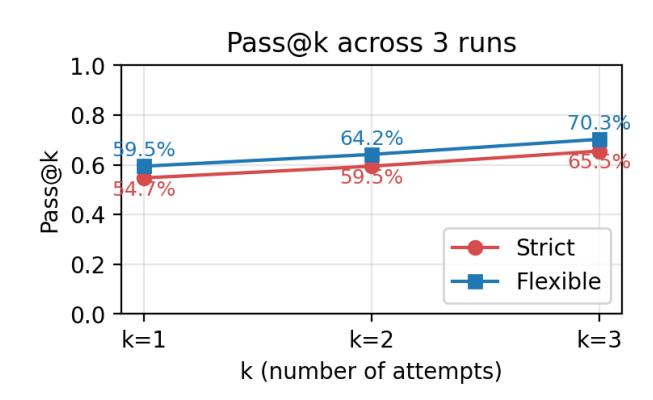
Additionally, we evaluate pass@k across three runs to assess the benefit of multiple attempts (Figure 4). For the strict setting, the pass rates increase from 54.7% at pass@1 to 59.5% at pass@2 and 65.5% at pass@3. Under the flexible setting, the corresponding rates are higher, rising from 59.5% to 64.2% and 70.3%. These results demonstrate that multiple agentic trials substantially improve performance, which may better control the stochastic nature of AI agents. Repeated experiments not only control for performance variance, but also help to validate the arguments based on performance.
6.2 Retrieval and Error Resolution
Figure 4: Pass@k performance of OSS-Build-Agent with LLM-Assisted Retrieval using GPT-4o. For K = 1, we report the earliest chronological run.
Despite the architectural differences between CompileAgent and OSS-Build-Agent, they both incorporate two similar modules of build instruction retrieval and agentic error resolution. We discuss the system design differences and their performance impact.
Retrieval Performance Analysis. Accurate retrieval of build instructions has a strong impact on subsequent compilation performance. Developerprovided instructions offer a solid starting point that agents can adapt to match specific configuration requirements or environment differences. In Build-Bench, we identified 136 OSS repositories from Build-Bench test set with clear instruction source labels (internal file paths or external web URLs) for the build instruction. Together, these form a secondary benchmark for evaluating the retrieval module described in Section 3.1.
We evaluated CompileAgent and OSS-Build-Agent's LLM-Assisted Retrieval (both using GPT-4o) on the secondary retrieval benchmark. The criterion for success is whether the retrieval module accesses the ground-truth instruction source labels, which may correspond to either an internal file within the repository (e.g., parsed as a GitHub URL) or an external website that hosts the build instruction for the given repository. We conducted additional experiments with respect to the sensitivity of base model choices (Table 4) and different retrieval strategies such as TF-IDF and RAG (Table 5). The results and further analysis can be found in the Appendix Section D.
In our evaluation, the retrieval module of OSS-Build-Agent achieved a retrieval accuracy of 73.8%, significantly outperforming CompileAgent's 46.2%. We attribute this performance improvement to key design choices in our retrieval module.
We observe that CompileAgent's retrieval tool favors certain files or pages and often avoids less obvious links, leading to missed instructions. For example, when given the structure of the root directory of a repository, agents usually pick build scripts (e.g., Makefile) as the retrieval target. Unfortunately, build scripts are often too noisy and can divert the agents from continuing to find explicit documentation about configuration or setup. Additionally, build instructions can exist across multiple sources (e.g., README files, wiki pages, and subdirectories), and the derailment of agents compounds when they face noise from the scattered instructions.
In comparison, we design the LLM-Assisted Retrieval module of OSS-Build-Agent as a workflow that mimics a human engineer. Rather, it focuses on exploring the documentation instead of the build process. In the first iteration of retrieval, we instruct the LLM to inspect the main README file to extract information or find useful build instruction sources. This prevents the LLM from being distracted by build scripts. Traversing a path of documentation files, our retrieval module better handles scattered information.
Retrieval Strategies for the Compilation Task. We evaluate how retrieval strategies affect OSS-Build-Agent's compilation performance (Table 3).
A Retrieval-Augmented Generation (RAG) Lewis et al. (2021) baseline is added for better comparison. The RAG corpus is built upon all internal documentation files and a README-seeded three-hop link crawl. We first extract all external web URLs referenced in the repository's README (depth 1). For each fetched page, we extract its outgoing URLs and repeat this expansion twice more (depths 2 and 3). We index the content of all pages at depths 1–3. The external web pages and internal documentation files together form the knowledge base for the RAG system to retrieve from. We also report a Perfect Retrieval ablation that adds the ground-truth build instructions directly to the OSS-Build-Agent's prompt.
All retrieval variants improve over the No Retrieval baseline. LLM-Assisted Retrieval consistently outperforms RAG in all metrics by a significant margin, with a 4.3% increase in the strict validated success percentage. It shows that targeted LLM-guided selection can provide agents with build signals of higher quality than RAG. As expected, Perfect Retrieval sets the upper bound on validated build success. It suggests that accurate retrieval of those human-written build instructions can drastically improve performance rather than merely increasing retrieval coverage. In general, these results confirm that the integration of retrieval is necessary for robust compilation and that the precision of the retrieval is the key factor in the validated gains.
Error Resolution Attempts. We compare two different agentic systems and manually inspect their action trajectories of error resolution. We observe that while CompileAgent employs a variety of tools, the main agent rarely invokes some of these tools (such as Multi-Agent Discussion for error resolution). The master agent usually exits too "easily" when encountering compilation errors, without attempting more fixes by invoking tools. Because compilation errors are often long, verbose, and nested, locating and fixing root-cause errors may require iterative attempts (interested readers may refer to an example in Appendix H). Thus, more error-resolution attempts are favorable, which is validated by our repeated experiments with OSS-Build-Agent as Table 2 shows. Using the same base model, we observe that the validated success rate scales well with the number of attempts to resolve the error.
Despite the scaling effect of error resolution attempts, OSS-Build-Agent makes 6.6 attempts on average, compared with 7.5 attempts by CompileAgent (excluding its retrieval module for fair comparison). This difference is due to our agent outputting the entire set of build commands, while CompileAgent outputs one Bash command at a time and refines it iteratively if execution shows an error. While this fine-grained approach can be effective, it also inflates the trajectory with trivial commands (e.g., ls, mkdir) that rarely fail but still count as separate steps. Conversely, OSS-Build-Agent generates a more complete set of compilation commands intended to drive the build to completion in a single run, followed by troubleshooting if needed. This design allows the agent to observe the full command history at each step, providing contextual information for error resolution. For example (details in Appendix G), an error such as The source directory does not appear to contain CMakeLists.txt can be resolved more effectively when the agent has access to prior directory navigation steps, enabling it to adjust the working directory and retry seamlessly.
Together, the agentic design in OSS-Build-Agent enables effective retrieval and error resolution, achieving superior performance with two agents (compared to seven in CompileAgent) and a simpler architecture. This demonstrates the competitive efficiency of our end-to-end agentic compilation pipeline.
6.3 Failure Modes of Agentic Build Methods
Agentic methods are known for instability, task derailment, disobeying instructions, and many other drawbacks (Cemri et al., 2025). Thus, it is important to identify the failure modes of the agents to facilitate the future development of more potent agents for the compilation task.
The most common failure arises from missing packages or version mismatches. Modern build systems typically validate dependency integrity before compilation, so unresolved package constraints would cause the compilation task to fail early. Yet we observe that agents do not possess enough information regarding specific versions or constraints of specific dependencies, preventing them from resolving the issue.
Insufficient troubleshooting is another noticeable failure mode for agentic compilation methods. Complex repositories often require several rounds of incremental repairs (e.g., addressing transitive headers, linker
Table 3: Ablation of retrieval strategies for OSS-Build-Agent. Values are percentages; parentheses show relative change vs No Retrieval baseline. Base model is o3-mini.
| Retrieval Method | Unvalidated (%) | Strict Success (%) | ||
|---|---|---|---|---|
| Strict | Flexible | |||
| OSS-BUILD-AGENT – No Retrieval (Baseline) | 67.6 | 48.0 | 50.7 | |
| OSS-BUILD-AGENT – LLM-Assisted Retrieval | 79.9 (+12.8) | 63.1 (+15.1) | 68.5 (+17.8) | |
| OSS-BUILD-AGENT – RAG (Ablation) | 76.4 (+8.8) | 58.8 (+10.8) | 64.9 (+14.2) | |
| OSS-BUILD-AGENT – Perfect Retrieval (Ablation) | 79.1 (+11.5) | 68.2 (+20.2) | 70.9 (+20.2) |
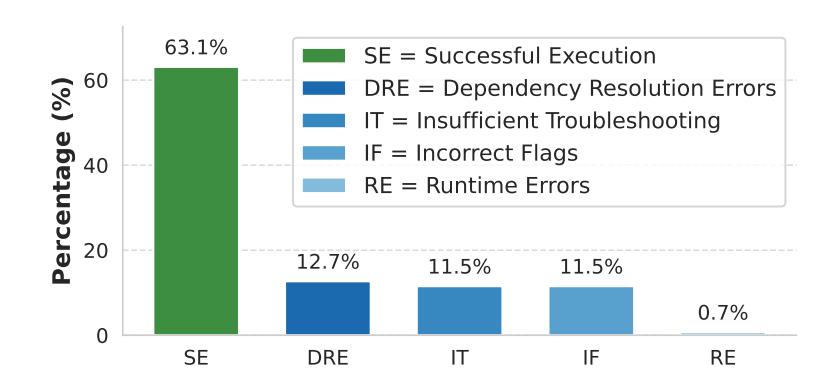
Figure 5: Agent failure-mode analysis of OSS-Build-Agent enhanced with LLM-Assisted Retrieval implemented with o3-mini.
flags, or generator invocations), but agents may quit early when determining the build is impossible after a few attempts. Moreover, another pattern is the under-exploration of build alternatives. Some projects support multiple build systems (e.g., CMake and a customized setup script), but agents may not explore all possible methods before failing on one method and quitting the work. We manually inspect the building process executed by OSS-Build-Agent, with the base model being o3-mini and the process being enhanced with the LLM-assisted retrieval approach. The results are shown in Figure 5.
Occasionally, the agent proposes a plausible Bash command in which the flags are ordered incorrectly or partially fabricated. Because link order and library grouping are order-sensitive in common toolchains, such mistakes will produce compilation or linking errors even when the base command is correct.
7 Related Work
LLMs have shown promising performance across various software engineering tasks. These include automated resolution of GitHub issues (Jimenez et al., 2024; Su et al., 2025), intelligent code generation (Ishibashi & Nishimura, 2024), automated test case generation (Pizzorno & Berger, 2025; Yuan et al., 2024), and Python software installation (Milliken et al., 2024). Within this growing landscape, the task of automatically compiling C/C++ OSS remains relatively underexplored. The intricacies of these languages, including discontinued maintenance, complex build systems that depend on many external dependencies, and the often less informative error messages from compilers like GCC and Clang (Onyango & Mariga, 2023), all add to the difficulty of the task. Rule-based methods have been used extensively in previous work on building binary datasets for downstream tasks (Hu, 2020; Lacomis et al., 2019; Liu et al., 2024). While such methods suffer from their inherent fragility, AI agents may be a suitable solution. Initial efforts such as CompileAgent (Hu et al., 2025) indicate the potential of agentic compilation, but their evaluation emphasizes well-known OSS whose build processes may be unusually well documented or memorized by LLMs. We believe it is necessary to create a more challenging benchmark drawn from a broader repository distribution to enable more insightful evaluation and analysis of agentic compilation methods.
8 Limitations
We evaluate solely on compiling C/C++ repositories on the Linux system, which is beneficial for many downstream tasks (Brust et al., 2023; Arasteh et al., 2025; Pal et al., 2024) that depend on datasets created in the same setting. Given that our method may be adaptable to other compilable programming languages or other operating systems, we leave them for future work.
Our strict and flexible validated-success metrics verify production of manually identified target artifacts, which is more reliable than accepting the presence of any binary. They do not, however, establish functional correctness: a produced artifact can still contain behavioral defects or fail project-specific tests. Full functional validation would require test suites or behavioral specifications, which are often unavailable, incomplete, or difficult to execute consistently across real-world OSS. Thus, we focus on measuring and reporting validated artifact-production rates rather than functional-correctness rates.
On the other hand, although OSS-Build-Agent shows competitive performance, we acknowledge the inherent instability of the agentic framework that may introduce variations in performance when reproducing the experiments. Also, we believe that agentic retrieval could be further enhanced with recent advancements in AI agent research, which ultimately improve the accuracy of the retrieval to enhance the overall compilation performance. We invite researchers to expand the potential of different agents' design philosophies and validate them on Build-Bench to facilitate real-life developers and downstream research.
9 Conclusion
In this paper, we present a more challenging benchmark for building C and C++ source-code repositories. Using Build-Bench, we conducted a rigorous evaluation of different compilation methods, including our top-performing agentic baseline, OSS-Build-Agent. Our analysis of agentic compilation modules pinpoints the challenging nature of the compilation task and sheds light on promising design choices. We hope that our work contributes a useful benchmark and inspires the community to build better agents for OSS compilation.
Broader Impact Statement
This work introduces BUILD-BENCH, a benchmark for evaluating LLM-based agents on compiling real-world open-source C/C++ projects, along with a strong baseline agent. The intended impact is to improve the study and practical reliability of agentic software compilation in realistic settings where build instructions are incomplete, dependencies are missing, and iterative troubleshooting is required.
Potential benefits. More reliable automated compilation could reduce time spent on environment setup and software "bit rot," improving reproducibility and lowering the barrier to reusing open-source implementations. It could also support downstream workflows that depend on compiled artifacts, such as large-scale program analysis and security research.
Potential risks. Compilation executes untrusted build scripts and may fetch dependencies or instructions from external sources. If used without strong isolation or containerization, this can create security risks (e.g., unintended code execution, data exposure, or supply-chain compromise).
Mitigation. We execute compilation in preconstructed Docker environments rather than on the host. Compilation agents should run only in ephemeral, sandboxed containers or VMs with minimal privileges, no mounted secrets, tight resource limits, and auditable logs. Where possible, network and dependency sources should be restricted or allowlisted. Pinned repository commits and cached instruction sources provide provenance for benchmark inputs and reduce exposure to upstream drift. Any agent-proposed source or build-script changes should be treated as untrusted and reviewed before reuse or redistribution. We provide the Dockerfiles and setup instructions needed to reproduce this isolation.
References
- Sima Arasteh, Georgios Nikitopoulos, Wei-Cheng Wu, Nicolaas Weideman, Aaron Portnoy, Mukund Raghothaman, and Christophe Hauser. BinPool: A Dataset of Vulnerabilities for Binary Security Analysis. In Proceedings of the 33rd ACM International Conference on the Foundations of Software Engineering, pp. 1183–1187. Association for Computing Machinery, New York, NY, USA, July 2025. ISBN 979-8-4007-1276-0. URL https://doi.org/10.1145/3696630.3728606. Tom B. Brown, Benjamin Mann, Nick Ryder, Melanie Subbiah, Jared Kaplan, Prafulla Dhariwal, Arvind Neelakantan, Pranav Shyam, Girish Sastry, Amanda Askell, Sandhini Agarwal, Ariel Herbert-Voss, Gretchen Krueger, Tom Henighan, Rewon Child, Aditya Ramesh, Daniel M. Ziegler, Jeffrey Wu, Clemens Winter, Christopher Hesse, Mark Chen, Eric Sigler, Mateusz Litwin, Scott Gray, Benjamin Chess, Jack Clark, Christopher Berner, Sam McCandlish, Alec Radford, Ilya Sutskever, and Dario Amodei. Language Models are Few-Shot Learners, July 2020. URL http://arxiv.org/abs/2005.14165. arXiv:2005.14165 [cs]. Clemens-Alexander Brust, Tim Sonnekalb, and Bernd Gruner. ROMEO: A binary vulnerability detection dataset for exploring Juliet through the lens of assembly language. Comput. Secur., 128(C), May 2023. ISSN 0167-4048. doi: 10.1016/j.cose.2023.103165. URL https://doi.org/10.1016/j.cose.2023.103165. Mert Cemri, Melissa Z. Pan, Shuyi Yang, Lakshya A. Agrawal, Bhavya Chopra, Rishabh Tiwari, Kurt Keutzer, Aditya Parameswaran, Dan Klein, Kannan Ramchandran, Matei Zaharia, Joseph E. Gonzalez, and Ion Stoica. Why Do Multi-Agent LLM Systems Fail?, April 2025. URL http://arxiv.org/abs/2503.13657. arXiv:2503.13657 [cs]. Mark Chen, Jerry Tworek, Heewoo Jun, Qiming Yuan, Henrique Pondé, Jared Kaplan, Harrison Edwards, Yura Burda, Nicholas Joseph, Greg Brockman, Alex Ray, Raul Puri, Gretchen Krueger, Michael Petrov, Heidy Khlaaf, Girish Sastry, Pamela Mishkin, Brooke Chan, Scott Gray, Nick Ryder, Mikhail Pavlov, Alethea Power, Lukasz Kaiser, Mo Bavarian, Clemens Winter, Philippe Tillet, F. Such,
-
D. Cummings, Matthias Plappert, Fotios Chantzis, Elizabeth Barnes, Ariel Herbert-Voss, William H. Guss, Alex Nichol, Igor Babuschkin, S. Balaji, Shantanu Jain, A. Carr, Jan Leike, Joshua Achiam, Vedant Misra, Evan Morikawa, Alec Radford, M. Knight, Miles Brundage, Mira Murati, Katie Mayer, P. Welinder, Bob McGrew, Dario Amodei, Sam McCandlish, I. Sutskever, and Wojciech Zaremba. Evaluating Large Language Models Trained on Code. ArXiv, July 2021. URL https://www. semanticscholar.org/paper/Evaluating-Large-Language-Models-Trained-on-Code-Chen-Tworek/ acbdbf49f9bc3f151b93d9ca9a06009f4f6eb269. William Gemmell Cochran. Sampling Techniques. Wiley, 1977. ISBN 978-81-265-1524-0. Google-Books-ID: xbNn41DUrNwC. Luke Dramko, Jeremy Lacomis, Pengcheng Yin, Ed Schwartz, Miltiadis Allamanis, Graham Neubig, Bogdan Vasilescu, and Claire Le Goues. DIRE and its Data: Neural Decompiled Variable Renamings with Respect to Software Class. ACM Trans. Softw. Eng. Methodol., 32(2):39:1–39:34, March 2023. ISSN 1049-331X. doi: 10.1145/3546946. URL https://dl.acm.org/doi/10.1145/3546946. Li Hu, Guoqiang Chen, Xiuwei Shang, Shaoyin Cheng, Benlong Wu, Gangyang Li, Xu Zhu, Weiming Zhang, and Nenghai Yu. CompileAgent: Automated Real-World Repo-Level Compilation with Tool-Integrated LLM-based Agent System, May 2025. URL http://arxiv.org/abs/2505.04254. arXiv:2505.04254 [cs]. Zecong Hu. huzecong/ghcc: GitHub Cloner & Compiler, January 2020. URL https://github.com/ huzecong/ghcc/tree/master. Yoichi Ishibashi and Yoshimasa Nishimura. Self-Organized Agents: A LLM Multi-Agent Framework toward Ultra Large-Scale Code Generation and Optimization, April 2024. URL http://arxiv.org/abs/2404. 02183. arXiv:2404.02183 [cs]. Carlos E. Jimenez, John Yang, Alexander Wettig, Shunyu Yao, Kexin Pei, Ofir Press, and Karthik Narasimhan. SWE-bench: Can Language Models Resolve Real-World GitHub Issues?, November 2024. URL http: //arxiv.org/abs/2310.06770. arXiv:2310.06770 [cs].
- Takeshi Kojima, Shixiang Shane Gu, Machel Reid, Yutaka Matsuo, and Yusuke Iwasawa. Large Language Models are Zero-Shot Reasoners, January 2023. URL http://arxiv.org/abs/2205.11916. arXiv:2205.11916 [cs]. Jeremy Lacomis, Pengcheng Yin, Edward J. Schwartz, Miltiadis Allamanis, Claire Le Goues, Graham Neubig, and Bogdan Vasilescu. DIRE: A Neural Approach to Decompiled Identifier Naming, October 2019. URL http://arxiv.org/abs/1909.09029. arXiv:1909.09029 [cs]. Patrick Lewis, Ethan Perez, Aleksandra Piktus, Fabio Petroni, Vladimir Karpukhin, Naman Goyal, Heinrich Küttler, Mike Lewis, Wen-tau Yih, Tim Rocktäschel, Sebastian Riedel, and Douwe Kiela. Retrieval-Augmented Generation for Knowledge-Intensive NLP Tasks, April 2021. URL http://arxiv.org/abs/ 2005.11401. arXiv:2005.11401 [cs]. Chang Liu, Rebecca Saul, Yihao Sun, Edward Raff, Maya Fuchs, Townsend Southard Pantano, James Holt, and Kristopher Micinski. Assemblage: Automatic Binary Dataset Construction for Machine Learning. In A. Globerson, L. Mackey, D. Belgrave, A. Fan, U. Paquet, J. Tomczak, and
- C. Zhang (eds.), Advances in Neural Information Processing Systems, volume 37, pp. 58698–58715. Curran Associates, Inc., 2024. URL https://proceedings.neurips.cc/paper\_files/paper/2024/file/ 6bbefc73a187dd42e0dc065b4e7a0615-Paper-Datasets\_and\_Benchmarks\_Track.pdf. Louis Milliken, Sungmin Kang, and Shin Yoo. Beyond pip install: Evaluating LLM Agents for the Automated Installation of Python Projects, December 2024. URL http://arxiv.org/abs/2412.06294. arXiv:2412.06294 [cs]. Kevin Agina Onyango and Geoffrey Wambugu Mariga. Comparative Analysis on the Evaluation of the Complexity of C, C++, Java, PHP and Python Programming Languages based on Halstead Software Science. International Journal of Computer and Information Technology(2279-0764), 12(1), March 2023. ISSN 2279- 0764. doi: 10.24203/ijcit.v12i1.294. URL https://www.ijcit.com/index.php/ijcit/article/view/294. Number: 1. Kuntal Kumar Pal, Ati Priya Bajaj, Pratyay Banerjee, Audrey Dutcher, Mutsumi Nakamura, Zion Leonahenahe Basque, Himanshu Gupta, Saurabh Arjun Sawant, Ujjwala Anantheswaran, Yan Shoshitaishvili, Adam Doupé, Chitta Baral, and Ruoyu Wang. "Len or index or count, anything but v1": Predicting Variable Names in Decompilation Output with Transfer Learning. In 2024 IEEE Symposium on Security and Privacy (SP), pp. 4069–4087, May 2024. doi: 10.1109/SP54263.2024.00152. URL https://ieeexplore.ieee.org/document/10646727. ISSN: 2375-1207. Juan Altmayer Pizzorno and Emery D. Berger. CoverUp: Effective High Coverage Test Generation for Python, May 2025. URL http://arxiv.org/abs/2403.16218. arXiv:2403.16218 [cs]. Noah Shinn, Federico Cassano, Edward Berman, Ashwin Gopinath, Karthik Narasimhan, and Shunyu Yao. Reflexion: Language Agents with Verbal Reinforcement Learning, October 2023. URL http: //arxiv.org/abs/2303.11366. arXiv:2303.11366 [cs]. Yifan Song, Guoyin Wang, Sujian Li, and Bill Yuchen Lin. The Good, The Bad, and The Greedy: Evaluation of LLMs Should Not Ignore Non-Determinism, July 2024. URL http://arxiv.org/abs/2407.10457. arXiv:2407.10457 [cs]. Hongjin Su, Ruoxi Sun, Jinsung Yoon, Pengcheng Yin, Tao Yu, and Sercan Ö Arık. Learn-by-interact: A Data-Centric Framework for Self-Adaptive Agents in Realistic Environments, January 2025. URL http://arxiv.org/abs/2501.10893. arXiv:2501.10893 [cs]. Hugo Touvron, Thibaut Lavril, Gautier Izacard, Xavier Martinet, Marie-Anne Lachaux, Timothée Lacroix, Baptiste Rozière, Naman Goyal, Eric Hambro, Faisal Azhar, Aurelien Rodriguez, Armand Joulin, Edouard Grave, and Guillaume Lample. LLaMA: Open and Efficient Foundation Language Models, February 2023. URL http://arxiv.org/abs/2302.13971. arXiv:2302.13971 [cs]. Zora Zhiruo Wang, Jiayuan Mao, Daniel Fried, and Graham Neubig. Agent Workflow Memory, September 2024. URL http://arxiv.org/abs/2409.07429. arXiv:2409.07429 [cs].
Danning Xie, Zhuo Zhang, Nan Jiang, Xiangzhe Xu, Lin Tan, and Xiangyu Zhang. ReSym: Harnessing LLMs to Recover Variable and Data Structure Symbols from Stripped Binaries. In Proceedings of the 2024 on ACM SIGSAC Conference on Computer and Communications Security, CCS '24, pp. 4554–4568, New York, NY, USA, December 2024. Association for Computing Machinery. ISBN 9798400706363. doi: 10.1145/3658644.3670340. URL https://dl.acm.org/doi/10.1145/3658644.3670340. Shunyu Yao, Jeffrey Zhao, Dian Yu, Nan Du, Izhak Shafran, Karthik Narasimhan, and Yuan Cao. ReAct: Synergizing Reasoning and Acting in Language Models, March 2023. URL http://arxiv.org/abs/2210. 03629. arXiv:2210.03629 [cs]. Shunyu Yao, Noah Shinn, Pedram Razavi, and Karthik Narasimhan. τ -bench: A Benchmark for Tool-Agent-User Interaction in Real-World Domains, June 2024. URL http://arxiv.org/abs/2406.12045. arXiv:2406.12045 [cs]. Zhiqiang Yuan, Yiling Lou, Mingwei Liu, Shiji Ding, Kaixin Wang, Yixuan Chen, and Xin Peng. No More Manual Tests? Evaluating and Improving ChatGPT for Unit Test Generation, May 2024. URL http://arxiv.org/abs/2305.04207. arXiv:2305.04207 [cs].
A Filtering Keywords
A portion of the keywords we used to filter out low-quality OSS includes:
homework, assignment, tutorial, exercise, solution, course, student, university, college, class, lecture, demo, practice, presentation, getting started, hello world, starter code, sample code, example code, documentation.
B Sample Size Estimation
To estimate the minimum sample size required to measure a population proportion with 95% confidence and a margin of error of 5%, the standard formula for proportion estimation is:
\[n_0 = \frac{Z^2 p(1-p)}{E^2}, \quad (1)\]where Z = 1.96 for a 95% confidence interval, E = 0.05 is the error margin, and p = 0.5 is chosen to maximize variance (i.e., yield the largest conservative sample size). This gives:
\[n_0 = \frac{1.96^2 \times 0.5 \times 0.5}{0.052} = 384.16.\]For finite populations, we apply the finite population correction (FPC) Cochran (1977):
\[n = \frac{n_0}{1 + \frac{n_0-1}{N}} = \frac{384.16}{1 + \frac{383.16}{6,568,809}} \approx 384.14. \quad (2)\] \[n = \frac{n_0}{1 + \frac{n_0-1}{N}} = \frac{384.16}{1 + \frac{383.16}{57,572}} \approx 384.14. \quad (3)\]We round up to obtain a final required sample size of n = 385. We accordingly conduct a random sample of 385 repositories from the previously mentioned corpus to compose the final test set.
C LLM prompts
Patch proposed by Agent
You are an expert at extracting only the most relevant information (such as build instructions, dependency requirements) for building a repository from source for Linux based on provided documentation. Oftentimes, the steps of compilation or building from source for Linux should have already been included in the this file, otherwise, they may be stored in one other local files or external links. Please do not include anything that's not directly related to building from source like community support, License, Developer/API Documentation, Contribution, installation instructions for other use cases (such as Python etc.) or other irrelevant information.
Additionally, identify up to three external links and up to three internal links within the documentation, following the above objective.
For external URLs, extract the full url.
For internal file paths, use {readme_dir} as the base path to complete the partial paths. Besides, refine the internal paths to ensure they are valid paths. For example, the /docs/HowToGuides/GettingStarted.md#installing-dependencies should be completed as {readme_dir}/docs/HowToGuides/GettingStarted.md, as the section name after # would interfere with the validity of the path.
If you determine that there is no information directly related to building from source on Ubuntu like community support, License, Contribution, installation instructions for other use cases (such as Python etc.) or other irrelevant information, simply fill the field of "Build_Instructions" with "No build instructions found" but still try to find useful urls or internal links for External_URLs and Internal_Paths.
C.2 LLM baseline prompts
Patch proposed by Agent
You are an expert Linux build engineer working inside a **Ubuntu-based Docker container**. The pre-installed software and libraries are as listed in the
following dockerfile content:
{per\_installed\_libraries\_in\_docker}
### Your task
Generate a **sequence of Bash commands** (one command per line, no comments, no
explanations) that will:
- Install every build-time dependency needed to compile the repository **{repo\_full\_name}** that lives at **{repos\_dir\_in\_docker}**.
* Use non-interactive apt-get update \&\& apt-get install -y ... when possible.
* Avoid PPAs unless strictly necessary.
* Assume you run as root, so no sudo is required. 2. **Detect build system and configure debug build:**
Examine the repository structure (files listed below) to choose the proper build configuration command. Configure the build system in Debug mode (i.e., include
DWARF symbols, disable optimizations).
- **Install the main binary:**
Identify the primary or main binary (for example, the one built from the project's
main executable) and install it into {repos\_dir\_in\_docker}
- Ensure the installation directory exists (create it if necessary with `mkdir
-p`).
- Copy the main binary into that directory and set executable permissions if
needed.
### Strict requirements:
***Output only Bash commands, separated using the newline character.**
Do not provide any explanations, markdown, or extra comments.
* The commands must be **fully sequential and ready-to-run** when concatenated. There should be no interactive prompts or assumptions beyond what is provided. * All steps must run successfully in a typical Docker Ubuntu environment.
* Assume the current working directory is ** "/app" **.
### Repository context
**Repo name:** {repo\_full\_name}
**Root path in container:** {repos\_dir\_in\_docker}
**README:** {readme\_content}
**Top-level file list:** {files\_in\_root\_dir}
C.3 System Prompt for Bash Command Generator
Patch proposed by Agent
You are an helpful AI assistant that is an expert in compiling cloned GitHub repositories and handling compilation errors during the process by generating bash commands.
The current working directory is /app, and all commands must use absolute paths referencing the repository's specific clone directory, with no placeholders. The compilation process runs inside a Docker container with root access, so do not use sudo. Your suggested code must be complete and executable, as the user cannot modify it. Ensure the target repository is compiled with debug information, for instance by adding -g -O0 to compiler flags, and do not strip this information after compilation. Whenever possible, use a prefix or DESTDIR flag during the make command to save compiled artifacts inside the clone directory. Always run make install after compilation, using multiple cores to speed up the process, but do not run make check or make test. More detailed building instructions from the repository will be provided, which you must follow. You should attempt to fix any errors that occur. To end the process upon success or failure, send a message explaining the reason followed by the word "terminate," but never include "terminate" in a response that also contains a code block. Do not show appreciation in your responses; if "Thank you" is said, reply only with "TERMINATE".
C.4 System Prompt for Executor Agent
System Prompt:
You are an AI assistant that can run bash commands or execute function calling and conduct the process of GitHub repository compilation.
Table 4: LLM-Assisted Retrieval module with different base model choices.
| Model | Build Instruction Overall (n=136) | Source Prediction Accuracy Out-of-repo (n=18) | Retrieval Trajectory Coverage (n=136) | ||
|---|---|---|---|---|---|
| GPT-4o | 73.8% | 5.6% | 81.2% | ||
| o3-mini | 72.8% | 5.6% | 81.0% | ||
| Gemini | 2.5 | Flash | 74.3% | 22.2% | 82.7% |
| Claude | 3.7 | Sonnet | 75.0% | 27.8% | 84.0% |
| Qwen3 | 235B | 74.3% | 22.2% | 82.5% | |
| Qwen3 | Coder | 480B | 72.8% | 11.1% | 81.2% |
Table 5: Comparison of retrieval methods in terms of accuracy and retrieval cost per repository.
| Avg HTTP | |||||
|---|---|---|---|---|---|
| Requests / | |||||
| Avg Monetary Cost / Repo | |||||
| TF-IDF | 63.2% | N/A | N/A | N/A | |
| RAG | 77.2% | 0.0% | 64.4 | ~0.32M tokens (0.04 USD) | |
| using text-embedding-3-large | |||||
| Retrieval | (Ours) | ||||
| 75.0% | 27.8% | Max 9 | ~45K input + ~780 output tokens (0.11 USD) | ||
| using GPT-4o |
D Retrieval Benchmark
We evaluate retrieval baselines on the secondary retrieval benchmark described in Section 6.2.
Base model sensitivity. In Table 4, we conduct additional experiments regarding our retrieval module, LLM-Assisted Retrieval, against different base models. Meanwhile, we also measure the retrieval trajectory coverage with the ground-truth labels, measuring how many intermediate instruction sources have been captured by our retrieval modules. The results show that our retrieval module can capture around 80% of intermediate URLs or internal files, as well as the potentially useful build instructions contained in them.
Retrieval strategies on the retrieval benchmark. We additionally implement a lightweight heuristic retrieval method TF-IDF as one of the retrieval baselines. The results are shown in Table 5.
For TF-IDF and RAG, we use a consistent Hit@5 metric: a prediction is correct if the ground-truth instruction source appears among the sources of the top-5 retrieved text snippets.
TF-IDF (in-repo documentation files only, since it is unable to explore external URLs) achieves 63.2%, whereas the RAG baseline achieves 77.2%. Our LLM-assisted retriever (Claude 3.7 Sonnet), on the 18 repositories whose ground truths are external URLs, reaches 27.8% versus 0% for RAG. It also uses far fewer HTTP requests than RAG requires to build its knowledge base. These results suggest that lightweight heuristics (TF-IDF/RAG) are efficient and strong for in-repo instructions, whereas our LLM retriever substantially improves coverage on long-tail external instruction pages.
Table 6: Comparison of time and API cost per repository across different compilation agents.
| Method | Time | Cost per Repo (min) LLM API Cost | per Repo (USD) |
|---|---|---|---|
| OSS-BUILD-AGENT | (GPT-4o) | 5.27 | $0.34 |
| CompileAgent | (GPT-4o) | 6.70 | $0.16 |
| GHCC | (Rule-Based) | 0.80 | 0 |
| Assemblage | (Rule-Based) | N/A | 0 |
E Time and Monetary Cost
Here, we report the additional metrics that can be used to evaluate the cost of our methods. Results are shown in Table 6.
We use GPT-4o as a reference for fair comparison with CompileAgent. On average across three runs, roughly 87K input tokens and 1.6K output tokens are consumed to compile each repository, combining to 0.23 USD. Also, taking into account the retrieval cost, averaging 0.11 USD using GPT-4o, the total is around 0.34 USD per repo.
In terms of time consumption, since all the experiments using OSS-BUILD-AGENT are conducted on the Kubernetes cluster, with 10 CPU cores assigned per repository, and the baseline experiments are done on a single local server with default settings, we can only provide reference time consumption below. Assemblage does not release a reference time cost analysis in its manuscript.
We observed minor differences between the public implementation and the manuscript. We therefore report CompileAgent costs as reported in its manuscript. Moreover, GHCC shows minimal time consumption due to its one-shot execution strategy: if the initial attempt fails, it terminates immediately without retrying.
F Case Study 1: Agentic Compilation patching source files
During our log analysis, we observe that in some cases Agentic Compilation attempts to fix the source files after encountering compilation errors and then continues building the project. The s9xie/hed repository, part of Build-Bench, has a code base that is 10 years old and relies on outdated packages and dependencies. It uses OpenCV v3 API calls and was originally built to run on Ubuntu 14. Newer versions of OpenCV v4 update their API, which causes this project to fail to build out-of-the-box on recent versions of Ubuntu. Based on the error log that the agent received as part of the feedback loop, it automatically patched the source files, updating the occurrences of the old API, and successfully compiled the repository. For instance, it updated CV_LOAD_IMAGE_COLOR to IMREAD_COLOR. It showcases the potential of an AI-based compilation method for patching repositories deemed 'uncompilable,' whereas a rule-based approach would never be able to fix it automatically without human assistance.
Error Log /app/k8s_compiled_repos/hed/src/caffe/layers/window_data_layer.cpp: In member function 'virtual void caffe::WindowDataLayer
Patch proposed by Agent
Agent Compilation : bash # Patch the OpenCV constants to use new names (IMREAD\_COLOR and IMREAD\_GRAYSCALE) in the affected source files. *,*→ sed -i 's/CV\_LOAD\_IMAGE\_COLOR/IMREAD\_COLOR/g' /app/k8s\_compiled\_repos/hed/src/caffe/util/io.cpp *,*→ sed -i 's/CV\_LOAD\_IMAGE\_GRAYSCALE/IMREAD\_GRAYSCALE/g' /app/k8s\_compiled\_repos/hed/src/caffe/util/io.cpp *,*→ sed -i 's/CV\_LOAD\_IMAGE\_COLOR/IMREAD\_COLOR/g' /app/k8s\_compiled\_repos/hed/src/caffe/layers/window\_data\_layer.cpp *,*→
\
\
\
\
G Case Study 2: CMake Error due to Directory Changes
Agents fail to compile repositories for various reasons, as described in 6.3. For instance, when compiling the GitHub repository bernhard-schmitzer/optimal-transport, the agent invoked cmake from the wrong working directory; further troubleshooting would have revealed that the CMakeLists.txt resides in the src subdirectory. While changing to a different directory is a simple and straightforward solution, the agent did not perform sufficient troubleshooting.
Compilation commands
```bash cd /app/k8s_compiled_repos/optimal-transport/v0.2.0 mkdir -p build && cd build cmake -DCMAKE_BUILD_TYPE=Debug -DCMAKE_CXX_FLAGS="-g -O0" -DCMAKE_C_FLAGS="-g -O0" .. \ ,→ make -j15 make install DESTDIR=/app/k8s_compiled_repos/optimal-transport
```
Execution log
exitcode: 2 (execution failed) CMake Error: The source directory "/app/k8s_compiled_repos/optimal-transport/v0.2.0" does not appear to contain CMakeLists.txt. ,→ \ ,→
\
H Case Study 3: Insufficient Troubleshooting
Agents fail to compile repositories for various reasons, as described in 6.3. For instance, when compiling the GitHub repository blitz3d-ng/package , the agent attempts to first initialize the Git submodules and then execute make to compile the repository. However, the execution fails. First, the current user running the git submodule update command is not the owner of the specified repository directory, causing a dubious ownership error. This then results in a follow-up error in make that indicates No rule to make target 'install'.
To resolve the error, the agent must address the submodule initialization error, as it is the root cause. If the agent focuses only on tackling the follow-up make error, the resolution will ultimately fail, highlighting the need for agents to diagnose and fix the primary issue in the execution chain.
Compilation commands
bash apt-get update apt-get install -y git ninja-build libxml2-dev zlib1g-dev build-essential autoconf libtool gettext autopoint gperf cmake clang libwxgtk3.0-gtk3-dev libxrandr-dev libxinerama-dev libxcursor-dev uuid-dev libfontconfig1-dev *,*<sup>→</sup> \ *,*→ cd /app/compiled\_repos/package git submodule update --init --recursive source /app/k8s\_compiled\_repos/package/env.sh make -j15 llvm make -j15 CPPFLAGS='-g -O0' CXXFLAGS='-g -O0' make install PREFIX=/app/compiled\_repos/package
\
Execution log
exitcode: 2 (execution failed) git submodule update failed:
fatal: detected dubious ownership in repository at
'/app/k8s_compiled_repos/package'
\
,→
...
make install failed: No rule to make target 'install'
I Information about Repositories
Table 7: The composition of BuildBench
| Project | Commit | Topic | Existing | Guide | No Guide |
|---|---|---|---|---|---|
| InRepo | NotInRepo | ||||
| LithiumX | cbea933 | gaming | ✓ | × | × |
| virgil-crypto | 6a8f44c | crypto | ✓ | × | × |
| cqmetrics | 5466255 | metrics | ✓ | × | × |
| infact | 449cff9 | c-plus-plus | × | ✓ | × |
| OpenOCD-Nuvoton | 4c38f37 | networking | ✓ | × | × |
| freesasa | 8872ee3 | bioinformatics | ✓ | × | × |
| librtmp | 808fe91 | networking | × | × | ✓ |
| stderred | 49e5537 | cli | ✓ | × | × |
| dhewm3 | 86152bb | gaming | ✓ | × | × |
| LISP | 0260bd5 | interpreter | ✓ | × | × |
| hostap-wpa3 | 72e2975 | security | ✓ | × | × |
| pure-lang | 01603c4 | functional-programming | × | ✓ | × |
| andvaranaut | 9823fef | gaming | ✓ | × | × |
| srs | c86db48 | networking | × | ✓ | × |
| fsarchiver | 276e0b8 | linux | × | ✓ | × |
| PGE | 8801301 | gaming | ✓ | × | × |
| is_jsonb_valid | 260fee3 | database | ✓ | × | × |
| bimpy | de83af5 | gui | ✓ | × | × |
| leopard | 6e5725e | database | × | × | ✓ |
| rvmparser | de6df5c | parser | ✓ | × | × |
| android-performance | b6b5590 | android | × | ✓ | × |
| MaslOS | a9b464a | kernel | ✓ | × | × |
| megaglest-source | 2e1b4c4 | gaming | ✓ | × | × |
| sharebox-fs | 1dc7a7a | filesystem | × | × | ✓ |
| mclinker | 8049238 | c-plus-plus | ✓ | × | × |
| patcher9x | a115854 | patch | ✓ | × | × |
| berkeley-softfloat-3 | a0c6494 | c | × | ✓ | × |
| spacenavd | df7a61e | driver | ✓ | × | × |
| AmBinaryEditor | a119c2a | android | × | × | ✓ |
| mm3d | 095cd21 | 3d-model | ✓ | × | × |
| ULTRA | 79f8de8 | algorithms | ✓ | × | × |
| gdal | d66e610 | raster | × | ✓ | × |
| xprompt | 11a9027 | x11 | ✓ | × | × |
| Proxifier-For-Linux | 64456c5 | proxifier | ✓ | × | × |
| luaevent | 9bc7745 | bindings | ✓ | × | × |
| ggmorse | 8fb433d | remote-sensing | ✓ | × | × |
| SourceAutoRecord | 6fb7496 | gaming | ✓ | × | × |
| oscam-patched-old | c9fada5 | softcam | ✓ | × | × |
| DupGen_finder | 54b9502 | bioinformatics | ✓ | × | × |
| xz | dd4a1b2 | c | ✓ | × | × |
| openat | 7bac754 | finance | ✓ | × | × |
| sysuh3c | f6df626 | networking | ✓ | × | × |
| nOS | 4af6982 | microcontrollers | × | ✓ | × |
| lightweight-crypto | fa4ec9a | crypto | ✓ | × | × |
| telegram-bot-api | 2e1fb03 | telegram | ✓ | × | × |
| jsonsl | 684b60f | networking | ✓ | × | × |
| trocksdb | d4b2d9f | database | ✓ | × | × |
| pgmagick | 7b135c0 | c-plus-plus | ✓ | × | × |
| vkcube | ffd5669 | c | × | × | ✓ |
| SignalRecovery | 5a6c501 | c | ✓ | × | × |
| rover | a7f4986 | file-browser | ✓ | × | × |
| EasyRTSPLive | 0e826cc | rtsp | ✓ | × | × |
Table 8: The composition of BuildBench
| Project | Commit | Topic | Existing | Guide | No Guide |
|---|---|---|---|---|---|
| InRepo | NotInRepo | ||||
| yuv2rgb | 64a25d5 | c | ✓ | × | × |
| ssocks | c202478 | networking | ✓ | × | × |
| myMPD | 3b253d8 | audio | × | ✓ | × |
| ircDDBGateway | 6680e4b | networking | ✓ | × | × |
| Doom8088 | 44e3a3f | gaming | ✓ | × | × |
| Lampray | 29d9296 | gaming | ✓ | × | × |
| Pangolin | b91d462 | 3d-model | ✓ | × | × |
| mercury | da18d76 | hpc | × | ✓ | × |
| navmesh | 6c80887 | c-plus-plus | ✓ | × | × |
| nginx-http-shibboleth | 629ae1f | nginx | × | ✓ | × |
| cavif | 4dea337 | graphics | ✓ | × | × |
| TexasSolver | 0e78a72 | gaming | × | × | ✓ |
| prefix | e25cf6e | database | ✓ | × | × |
| file | 74e451b | c | ✓ | × | × |
| realm-core | 5aeef51 | database | ✓ | × | × |
| redis-leveldb | e807fe2 | caching | ✓ | × | × |
| tbox | d0d87d8 | networking | ✓ | × | × |
| parrot | 75bc846 | virtual-machine | ✓ | × | × |
| mpio | e2a6165 | c-plus-plus | × | × | ✓ |
| G1fitting | a338d59 | c-plus-plus | ✓ | × | × |
| libxd | 2b0e02c | graphics | × | ✓ | × |
| webserver | 29a237a | networking | × | × | ✓ |
| TinyBIOS | 70838b6 | operating-system | ✓ | × | × |
| quartz | c22e1aa | emulator | ✓ | × | × |
| csldr | 4584077 | gaming | × | × | ✓ |
| nap | 917eeae | graphics | × | ✓ | × |
| pysqlite3 | ca81079 | database | ✓ | × | × |
| OpenGL-Renderer | 9a6c5fb | graphics | ✓ | × | × |
| shared | aa2f5d2 | c-plus-plus | ✓ | × | × |
| thot | 6ba76a1 | machine-learning | × | ✓ | × |
| SaBRe | 05816ee | binary-rewriting | ✓ | × | × |
| renderdoc | 8649146 | graphics | ✓ | × | × |
| that_editor | 70dd66a | editor | ✓ | × | × |
| simdjson_php | 9a27456 | php | ✓ | × | × |
| libRaptorQ | a394b22 | c-plus-plus | ✓ | × | × |
| QHotkey | 6c0e984 | cross-platform | ✓ | × | × |
| PIMSim | 67c0fb6 | emulator | ✓ | × | × |
| tracer | ecad33e | graphics | ✓ | × | × |
| gtsa | fc82d49 | gaming | ✓ | × | × |
| dplus-c | 307bb08 | android | × | × | ✓ |
| otherside | 1d394e3 | virtual-machine | ✓ | × | × |
| libmolgrid | 025b7b2 | machine-learning | ✓ | × | × |
| obsqr | 175b424 | android | ✓ | × | × |
Table 9: The composition of BuildBench
| Project | Commit | Topic | Existing | Guide | No Guide |
|---|---|---|---|---|---|
| InRepo | NotInRepo | ||||
| fftocean | 9396b37 | c-plus-plus | ✓ | × | × |
| HOLLOW | 0482296 | c | ✓ | × | × |
| dbcc | cac441d | c | ✓ | × | × |
| rocketmq-client-cpp | 58fbd95 | rocketmq | ✓ | × | × |
| MNN | 11634a1 | machine-learning | × | ✓ | × |
| pepecoin | 4fb5a0c | crypto | ✓ | × | × |
| bxxt | 02bf3bb | c | ✓ | × | × |
| Quartic | 45bf9bb | c-plus-plus | ✓ | × | × |
| csol | b3bd193 | gaming | ✓ | × | × |
| cli-gpt | c5ed06e | machine-learning | ✓ | × | × |
| eekf | 2ae1783 | c | ✓ | × | × |
| mx | 63da1f2 | c | ✓ | × | × |
| atto | 0b2c5bb | editor | ✓ | × | × |
| lucy | ccf6fc8 | attic | ✓ | × | × |
| uvConvertor | 91a323f | c-plus-plus | ✓ | × | × |
| WendzelNNTPd | d1b8e59 | database | ✓ | × | × |
| vxsig | 0366c9f | antivirus | ✓ | × | × |
| pg_amqp | 240d477 | database | ✓ | × | × |
| RtspServer | 1fe0ac9 | networking | ✓ | × | × |
| ctypes.sh | 62ec33a | editor | ✓ | × | × |
| Turbo-Base64 | 9292363 | crypto | ✓ | × | × |
| berserk | 19f96bd | gaming | ✓ | × | × |
| TheWiggler | 226a66c | c-plus-plus | ✓ | × | × |
| poedit | ebb1535 | translation | ✓ | × | × |
| fastq-tools | acf479f | c | ✓ | × | × |
| munge | 221f3c5 | hpc | × | ✓ | × |
| ChowDSP-VCV | 023de1d | networking | ✓ | × | × |
| sxhkd | b0923b6 | c | × | × | ✓ |
| GuiLite | e9c4b57 | c-plus-plus | ✓ | × | × |
| pslab-firmware | 37b91ab | hardware | ✓ | × | × |
| package | d8d5d1b | 3d-model | ✓ | × | × |
| DuckX | 53f880f | c-plus-plus | ✓ | × | × |
| Brayns | 747afcd | graphics | ✓ | × | × |
| PLADE | 29ad9b5 | c-plus-plus | ✓ | × | × |
| spot-on | 6a03da6 | c-plus-plus | ✓ | × | × |
| air | d04f4ef | php | ✓ | × | × |
| cam2web | 9b5fd12 | graphics | ✓ | × | × |
| twemproxy | 60aaf85 | networking | ✓ | × | × |
| SNANDer | b4b14da | hardware | ✓ | × | × |
| aocla | 8fe16fa | c | ✓ | × | × |
| obs-gnome-screencast | 7034ee9 | linux | × | × | ✓ |
| Dwarf-Therapist | 63910f7 | gaming | × | ✓ | × |
| q4wine | f506d89 | wine | ✓ | × | × |
| libsrt | eee28e6 | c | ✓ | × | × |
| BundleFusion_Ubuntu_Pangolin | f350ab0 | 3d-model | ✓ | × | × |
| iotkit-embedded | 3010153 | iot | × | ✓ | × |
| semu | 43eef97 | emulator | ✓ | × | × |
| level-ip | c1950ea | networking | ✓ | × | × |
| NovaLSM | 8a66119 | database | ✓ | × | × |
| pysubnettree | 9a9ba8d | networking | ✓ | × | × |
| poster | dc7dd0b | operating-system | ✓ | × | × |
| Multi_Sensor_Fusion | 73c0f81 | graphics | ✓ | × | × |
| web-server | 4a515ad | multi-threading | ✓ | × | × |